How to Use a Kaleidoscope: Light, Rotation and Each Type Explained

Updated: 6 days ago
A kaleidoscope needs only three things from the person using it: light at the far end, the eye close to the eyepiece, and slow movement. Most disappointing first looks come from getting one of these wrong. This guide covers each type - wheel, cell and teleidoscope - the light sources that work, and how to photograph the image.
Short answer: hold the eyepiece close to one eye, point the far end at a bright but indirect light source such as a window, and turn the object end slowly - the wheel, the cell or the whole body, depending on the type. Never point a kaleidoscope at the sun.

Step by step
1. Find the light. Stand or sit facing a window in daylight, or a lamp in the evening. The light should fall on the object end, not into your eyes.
2. Hold it close. Put the eyepiece against, or just in front of, one eye. At a distance you see only part of the pattern and the edges go dark.
3. Turn slowly. A quarter turn every few seconds is enough. The pattern changes faster than it looks from outside, and fast turning blurs it.
4. Stop and look. Hold one image for a few seconds before moving on. The symmetry, the number of segments and the colour relationships are easier to read when the image is still.
How to use each type
Type | What you turn or move | Best light |
Wheel kaleidoscope | The wheel, with your thumb; the body stays still | Wheel facing a window or lamp |
Two-wheel or three-wheel | One wheel at a time, or both in opposite directions | Same as above |
Dry cell | The cell or the whole body; pieces tumble | Bright, even light behind the cell |
Oil cell | Turn, then wait; pieces keep drifting | Bright, even light behind the cell |
Teleidoscope | The whole instrument, across a scene | Well-lit subject; the light is in the scene, not behind it |

Wheel kaleidoscopes
A wheel is a fixed disc of glass, stone or resin segments on an axle in front of the mirrors. Because the pieces are fixed, you can return to a pattern you liked by turning back. On instruments with two wheels, turning them in opposite directions layers one pattern over the other; turning only the smaller rear wheel changes the background while the front stays still. The Architect’s Edition carries a 10 cm wheel with a 4 cm wheel behind it, and the 50th Anniversary Edition has three wheels of 8, 5 and 3 cm.
Cell kaleidoscopes
A cell is a closed chamber of loose pieces. In a dry cell, turning the instrument tumbles the pieces and each turn gives a new image that cannot be repeated. In an oil cell, the pieces move slowly through liquid: turn it, then hold it still and watch the image keep changing. The Giant Kaleidoscope uses a fluid-filled rotating cell.
Teleidoscopes
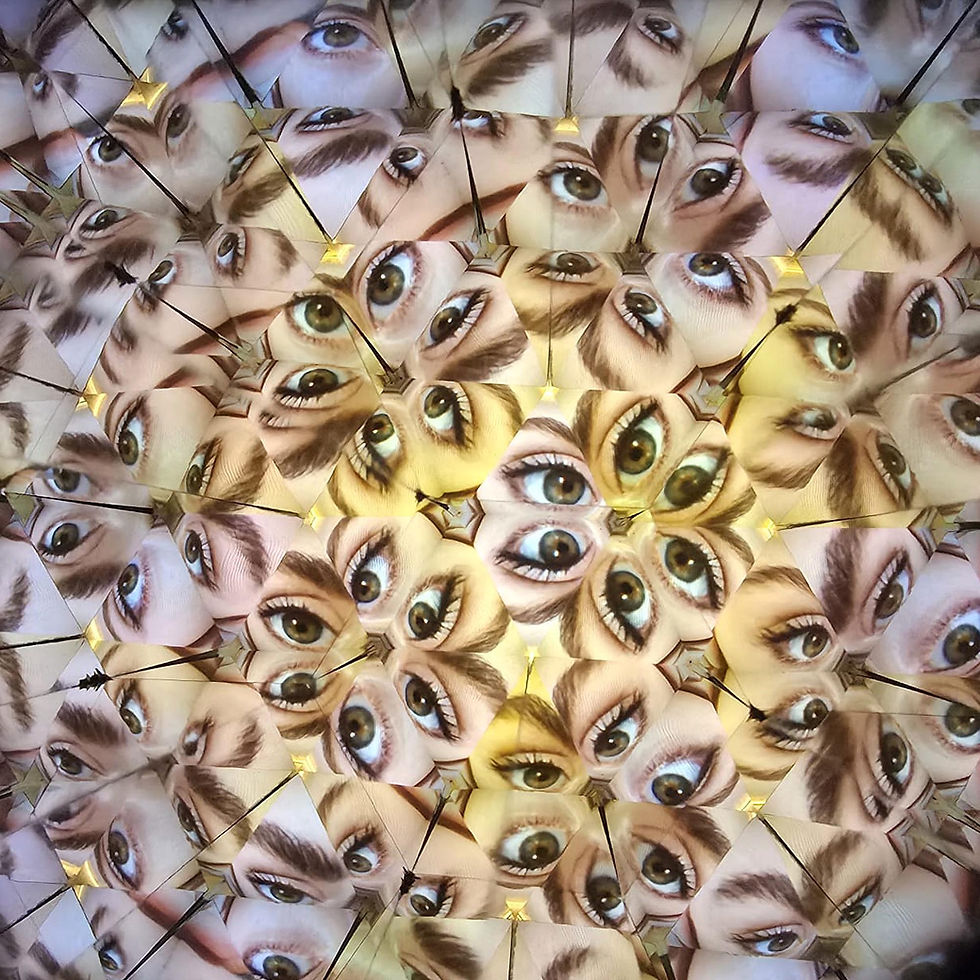
A teleidoscope has a lens instead of a cell, so the pattern is made from whatever it is pointed at. Try textures and edges: leaves, fabric, printed text, a bookshelf, a face across the table. Move the instrument slowly across the subject and change the distance; close subjects fill the field, far subjects repeat as small tiles. See What Is a Teleidoscope and the Brass Teleidoscope.
Light sources compared
Light source | Result |
Window daylight, indirect | Even light, full colour; the best starting point |
Desk or table lamp | Warmer colour and higher contrast; good in the evening |
Phone torch behind the wheel | Very bright; can wash out pale glass, so keep it at a distance |
Direct sunlight | Do not use; never point a kaleidoscope at the sun |
Photographing through a kaleidoscope
Hold the phone camera lens centred and flat against the eyepiece. Tap and hold on the screen to fix focus and exposure, otherwise the camera hunts as the pattern changes. Turn the wheel slowly while recording video; a stand keeps the instrument still. A teleidoscope can also be held against a camera or phone lens to produce the effect in camera, without software.
Care after use
Wipe the eyepiece and the wheel with a dry microfibre cloth. Do not open the tube: the mirrors are aligned at assembly and a small shift shows as a broken edge in the image. Store the instrument on its stand or lying flat, away from a sunny windowsill. Brass darkens where it is handled; that is normal. More in How to Care for a Brass Kaleidoscope.
Frequently asked questions
Why do I only see black when I look into a kaleidoscope?
There is not enough light reaching the far end. Point the object end at a window or a lamp. On a wheel instrument, the light has to pass through or reflect off the wheel, so the wheel should face the light.
Can I look at the sun through a kaleidoscope?
No. Never point any kaleidoscope or teleidoscope at the sun. A teleidoscope lens in particular concentrates light. Use daylight from a window, not direct sunlight.
Which way do I turn a kaleidoscope?
It depends on the type. On a wheel kaleidoscope, turn the wheel with your thumb while the body stays still. On a cell kaleidoscope, turn the cell or the whole body. A teleidoscope is not turned for colour; you move it across what it is pointed at.
Should I close my other eye?
Either works. Closing the other eye gives a cleaner image; keeping it open is less tiring over time. Hold the eyepiece close to the eye either way, so that the whole field is visible.
How do I photograph what I see in a kaleidoscope?
Hold the phone camera lens centred against the eyepiece, fix focus and exposure by tapping and holding on the screen, and turn the wheel slowly while recording. A stand keeps the instrument still.
How do I clean a kaleidoscope?
Wipe the eyepiece and the wheel with a dry microfibre cloth. Do not open the tube; the mirrors are aligned at assembly. Brass darkens where it is handled, which is normal.
Studio Yabaye builds wheel kaleidoscopes and teleidoscopes on brass tube in Israel, with first-surface mirrors, each signed by Rocco (Roi) Ramon, a licensed architect. Related reading: Types of Kaleidoscopes, History of the Kaleidoscope and What You See Inside a Handmade Brass Kaleidoscope.Related: how to light, view and photograph a kaleidoscope.


Comments